Short answer: Karl Benz is credited with inventing the first practical gasoline-powered car. He patented his three-wheeled Benz Patent-Motorwagen in Germany in 1886. But “first car” depends on what you count, and other inventors built self-propelled vehicles decades earlier.
Karl Benz and the 1886 Patent-Motorwagen
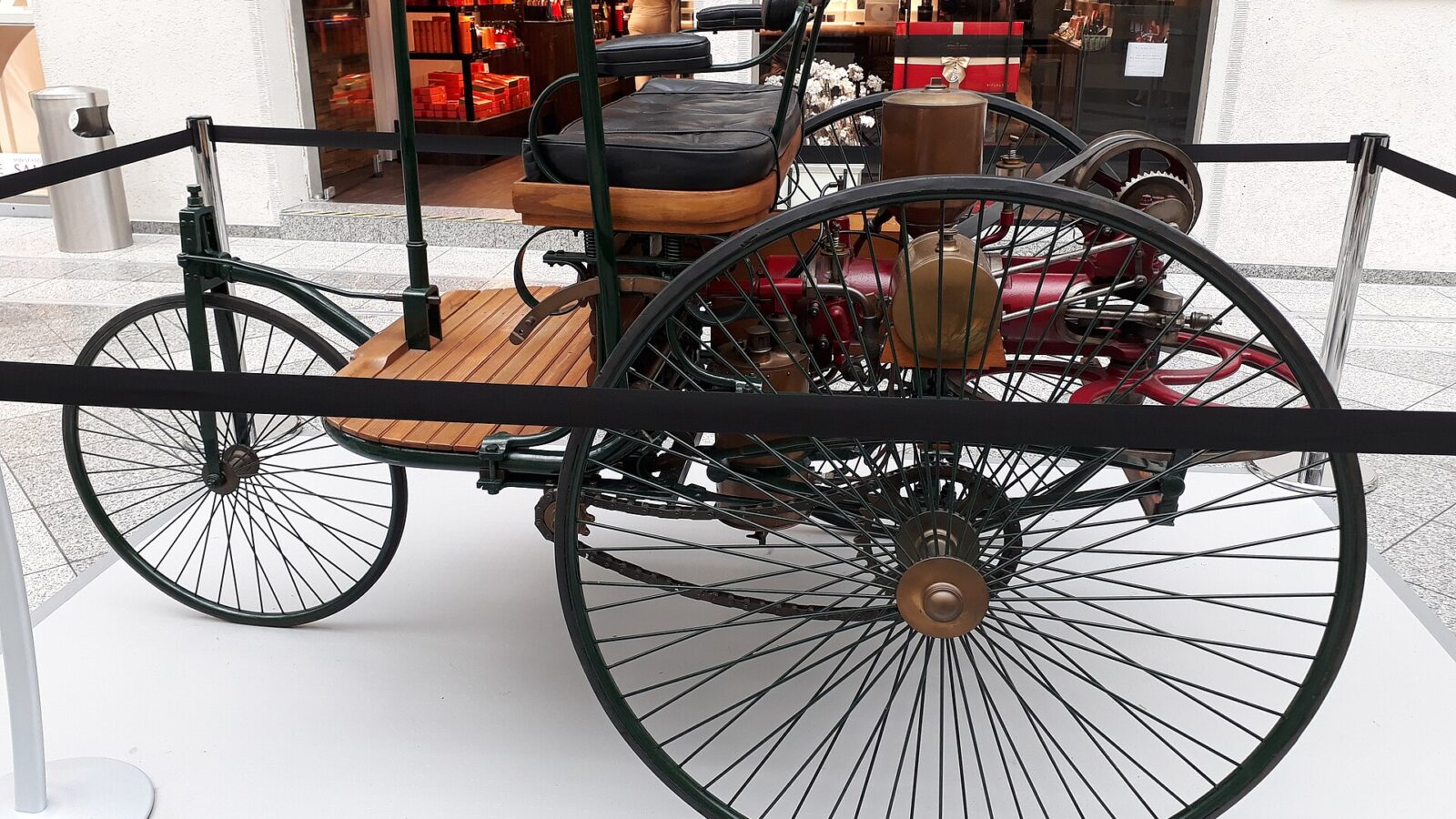
On January 29, 1886, Karl Benz filed German patent No. 37435 for a “vehicle powered by a gas engine.” His Motorwagen had three wire-spoked wheels, a single-cylinder four-stroke engine mounted at the rear, and a top speed of roughly 10 mph (16 km/h).
Benz gets the credit for one main reason: he designed the engine and the vehicle together as one machine. Earlier inventors had put engines on carts or carriages. Benz built a complete automobile from the start, then sold it to the public.
Bertha Benz proved it worked
The Motorwagen didn’t sell well at first. People didn’t trust it. In August 1888, Karl’s wife Bertha took the car, without telling him, and drove their two teenage sons about 66 miles (106 km) from Mannheim to her hometown of Pforzheim.
Along the way she bought fuel at a pharmacy, cleaned a clogged fuel line with a hatpin, and had a shoemaker add leather to the brakes. The trip got attention and showed the car could handle a real journey. Today the route is marked as the Bertha Benz Memorial Route.
Who built a self-propelled vehicle before Benz?
If “car” means any road vehicle that moves under its own power, Benz wasn’t first.
- Nicolas-Joseph Cugnot (1769): This French military engineer built a steam-powered tractor to haul cannons. It was slow and hard to control, but it moved on its own.
- Early electric carriages (1830s onward): Inventors in Scotland, the Netherlands, and the U.S. built small electric vehicles in the 1830s. Practical rechargeable batteries came later in the century.
- Siegfried Marcus (1870s): This Austrian inventor built gasoline-powered carts, but they were experimental and his dates are debated.
- Gottlieb Daimler and Wilhelm Maybach (1886): Working separately from Benz, they put a high-speed gasoline engine on a carriage the same year. Their companies later merged with Benz’s to form Daimler-Benz.
So who invented the car?
The fairest answer: no single person invented “the car.” Steam, electric, and gasoline vehicles developed alongside each other across the 1800s. Karl Benz built the first practical, production gasoline automobile, which is why most historians and Mercedes-Benz itself point to 1886 as the car’s birth year.
What about Henry Ford?
Henry Ford didn’t invent the car. He built his first experimental vehicle, the Quadricycle, in 1896, ten years after Benz. Ford’s big contribution came later: the Model T (1908) and the moving assembly line (1913) made cars cheap enough for ordinary families.
Quick timeline
| Year | Milestone |
|---|---|
| 1769 | Cugnot’s steam vehicle |
| 1886 | Benz patents the Motorwagen; Daimler and Maybach motorize a carriage |
| 1888 | Bertha Benz’s 66-mile drive |
| 1896 | Henry Ford’s Quadricycle |
| 1908 | Ford Model T goes on sale |
Want more history like this? Read our list of fun car facts.