Cars are so ordinary that it’s easy to forget how strange their history is. A woman invented the windshield wiper before most people had ever seen a car. A blind engineer invented cruise control. And for about a decade, Ford sold the Model T in exactly one color. Here are 35 fun car facts, grouped so you can skim.
Car facts about the very first automobiles
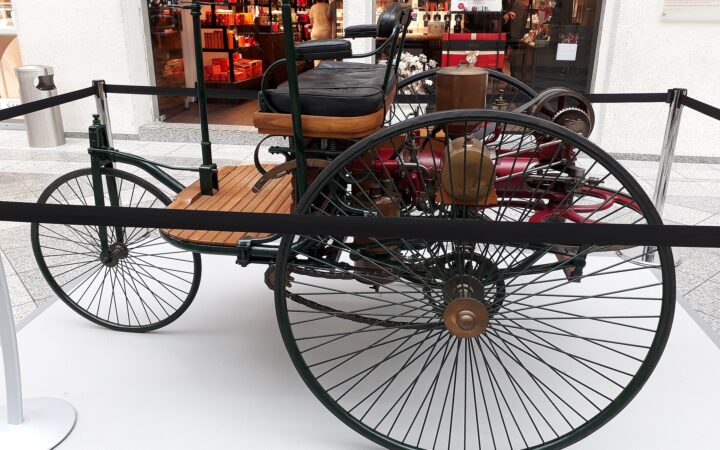
- The first practical gasoline car was patented in 1886. Karl Benz filed German patent No. 37435 for his three-wheeled “Patent-Motorwagen” on January 29, 1886. (More in who invented the first car.)
- The first long road trip was driven by a woman. In August 1888, Bertha Benz drove the Motorwagen about 66 miles (106 km) from Mannheim to Pforzheim, Germany, without telling her husband first.
- She bought fuel at a pharmacy. There were no gas stations, so Bertha Benz bought ligroin, a petroleum solvent, from a pharmacy in Wiesloch. That pharmacy is now called “the world’s first filling station.”
- Early cars had tillers, not steering wheels. Many of the first cars were steered with a lever, much like a boat.
- Electric cars came early. Around 1900, electric cars made up roughly a third of the vehicles on American roads, according to the U.S. Department of Energy.
- Hand cranks were dangerous. Before the electric starter, drivers started engines with a hand crank that could kick back and break an arm. Cadillac introduced the electric self-starter in 1912.
Car facts about famous inventions
- Mary Anderson patented the windshield wiper in 1903. She came up with the idea after watching a streetcar driver struggle to see through sleet.
- A blind engineer invented cruise control. Ralph Teetor, who lost his sight as a child, developed the “speedostat.” Chrysler first offered it in 1958.
- Volvo gave away its seat belt design. Engineer Nils Bohlin developed the modern three-point seat belt for Volvo in 1959, and Volvo made the patent available to other carmakers.
- “Motorola” comes from car radios. The Galvin Manufacturing Corporation named its 1930 car radio “Motorola,” combining “motor” with “-ola,” a popular ending for sound products. The company later took the name.
- Flashing turn signals arrived in 1939. Buick offered factory electric turn signals that year. Before that, drivers used hand signals.
- The first traffic light came before cars. London installed a gas-lit signal for horse traffic in 1868. Cleveland, Ohio, got an electric traffic signal in 1914.
- Horsepower was a marketing term. James Watt created the unit in the 1700s to compare his steam engines to the horses they replaced. See what horsepower really means.
Car facts about Ford and mass production
- The Model T launched in 1908 and stayed in production until 1927.
- Ford built more than 15 million Model Ts.
- The moving assembly line changed everything. After Ford introduced it in 1913, the time to build a Model T chassis dropped from about 12 hours to about 90 minutes.
- “Any color, as long as it’s black” was only true for part of the run. From about 1914 to 1925, the Model T came only in black. Early and late cars came in other colors.
- The price dropped as production rose. A Model T touring car cost $850 in 1908. By the mid-1920s, a Model T runabout sold for under $300.
Car facts about safety and the law
- The first speeding ticket was issued in 1896. In England, Walter Arnold was fined for going about 8 mph in a 2 mph zone.
- New York passed the first state seat belt law in 1984.
- New Hampshire is the only state without a seat belt law for adults.
- Seat belts cut the risk of death roughly in half. NHTSA estimates seat belts reduce the risk of fatal injury by 45% for front-seat passenger car occupants.
- Frontal airbags have been required on new cars since the 1998 model year (light trucks followed in 1999).
- The U.S. Interstate Highway System was authorized in 1956 by the Federal-Aid Highway Act.
Car facts about everyday features
- Every modern car has a 17-character fingerprint. Since the 1981 model year, vehicles sold in the U.S. use a standard 17-character VIN. Read what a VIN number is.
- VINs never use the letters I, O, or Q because they look too much like 1 and 0.
- Tires used to be white. Early rubber tires were light-colored. Adding carbon black made them stronger and turned them black. Here’s why tires are black.
- The gas gauge arrow tells you which side your fuel door is on. Most modern cars have a small triangle next to the fuel pump icon pointing to the correct side.
- “New car smell” is mostly chemicals. It comes from volatile organic compounds released by plastics, adhesives, and fabrics in the cabin.
- Every car sold in the U.S. since 1996 has OBD-II. This onboard diagnostic system is what turns on your check engine light.
- Your car has tens of thousands of parts. Toyota says a typical car has about 30,000 parts when you count every screw.
Car facts about record-setting models
- The Toyota Corolla is the best-selling nameplate in history. Toyota announced it had sold 50 million Corollas worldwide in 2021.
- The Volkswagen Beetle outlived the Model T. The original Beetle passed the Model T’s production total in 1972 and was built in Mexico until 2003.
- The Toyota Prius went on sale in Japan in 1997 as the first mass-produced hybrid car, and it reached the U.S. in 2000.
- Cars came before driver’s licenses. Early drivers often needed no license at all. Most U.S. states didn’t require driver testing until much later in the 20th century.
Why these car facts matter
Most of the features we take for granted, like wipers, seat belts, turn signals, and warning lights, were someone’s answer to a real problem. Knowing where they came from makes it easier to understand how your own car works and why certain rules exist. Browse the full Car Facts Library for more.
Sources
- Mercedes-Benz Group: Benz Patent Motor Car, the first automobile
- U.S. Department of Energy: The History of the Electric Car
- The Henry Ford: Model T collections
- ASME: Ford Model T Landmark
- NHTSA: Seat Belts
- NHTSA: Air Bags
- National Inventors Hall of Fame: Mary Anderson
- Toyota: Corolla reaches 50 million units